|
|
|
|
Historical perspective
One of the first applications of therapeutic ultrasound was in a technique that was originally termed “ultrasonic massage” developed in Berlin by Raimar Pohlman It improved blood circulation and was able to break down adhesion between muscles and sheaths to improve movement [1]. It was of course the beginning of the use of ultrasound in physiotherapy. Perhaps the most promising technique currently under investigation for the treatment of cancer is High Intensity Focussed Ultrasound (HIFU) and its origins can be traced back to around the same period as the work of Pohlman. Lynn et al used focused ultrasound to produce zones of tissue destruction deep in fresh liver tissue with minimal effects at the surface and no effects on the intervening tissue [2]. This was applied to animals through scalp and skull and produced local changes in the brain with temporary behaviour changes that had previously only been obtained through surgery. The range of applications of ultrasound in therapy currently used, under clinical trials or emerging from the laboratory is truly amazing especially as the major advances have only been in recent years [3].
1. Pohlman, et al, Über die Ausbreitung und Absorption des Ultraschalls im menschlichen Gewebe und seine therapeutische Wirkung an Ischias und Plexusneuralgie. Dtsch Med Wochenschr, 65. 261-256 (1939) 2. Lynn, J.G., et al., A new method for the generation and use of focused ultrasound in experimental biology. The Journal of General Physiology. 26(2), 179-193 (1942) 3. ter Haar, G., Therapeutic applications of ultrasound. Progress in Biophysics and Molecular Biology, 93(1-3): p. 111-129 (2007)
General Overview
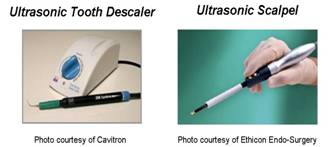
The use of high frequency ultrasound (around 5MHz) in medical imaging is a routine part of antenatal medicine to obtain an ultrasonic scan of the foetus in the womb. Such "diagnostic" ultrasound uses a refined pulse echo technique based upon the fact that sound waves are reflected to varying degrees from the interfaces between different tissue, blood and bone in the body. The reflections are processed to give a visual image. At lower ultrasonic frequencies energy inputs can be increased to a level where chemical effects become possible and this has given rise to a new field of medicine called therapeutic ultrasound. Such is the interest and expansion in this field of medicine that a new society devoted to the promulgation of the general area of ultrasound in non-diagnostic medicine has been established under the title “International Society for Therapeutic Ultrasound”. The society has a scientific committee chaired by Dr. G. ter Haar, Head of Therapeutic Ultrasound, Royal Marsden Hospital, Sutton, UK and Professor Mason is a member of the committee. Two purely mechanical applications of ultrasound have been in use for many years. · In Dentistry a common piece of equipment is an ultrasonic device used for cleaning and descaling teeth. There has been research into the use of the same equipment for assisting in the curing of (glass ionomer) white filling material. · In the hospital operating theatre another ultrasonic device is proving to be most useful – the ultrasonic scalpel. This device has a scalpel blade which vibrates ultrasonically and as a result reduces significantly the overall force required to cut. It also gives precise cutting and induces coagulation with minimal lateral tissue damage
Sono-Dynamic Therapy (SDT)
Transdermal drug delivery Physiotherapists use ultrasound at frequencies of between 1 and 3 MHz to treat muscle injury because applying ultrasound to the skin surface provides a localised heating/massage effect to the injury site. However the accompanying vibration also causes a temporary weakening of the barrier formed by the stratum corneum. Ultrasound can alter the barrier function of the skin to permit the administration of drugs not normally permeable through the skin layer. This approach to drug delivery shows potential for the transdermal delivery of: · antibiotics - where oral administration would not deliver the appropriate dose to the affected area, e.g. in severe acne or gangrene. · non-steroidal anti-inflammatory drugs - when taken orally over a long period may cause gastro-duodenal ulcers in many patients. · protein drug molecules - where enhancement of drug penetration through the skin could eliminate the need for injectable forms of insulin which currently 125 million people deal with on a daily basis. · Activation of dermal patches – for a rapid and instantaneous extra release of drugs through the skin
Improved uptake of drugs into cells Several in vitro studies show that low-intensity ultrasound can increase the uptake of chemotherapeutic agents to cancer cells. This increased intracellular drug accumulation is believed to be due to an alteration in the cell membrane permeability mediated by ultrasound.
HIFU The use of a focused array of transducers for use in cancer therapy (High-Intensity Focused Ultrasound known as HIFU) has been under investigation for many years. In principal the array is constructed to produce a focus within the body in the approximate shape of an elongated rugby football a few millimetres or so in cross section and several millimetres long. The focus can be targeted accurately on cancerous tissue within the body and, through the energy intensity generated at the focus, thermally destroy it. In a sequence of exposures the focus can be moved to cover the whole of the affected region. At lower powers the focused ultrasound can also be used to enhance the action of chemotherapy agents such as a porphyrin which are known to be affected region and is thought to promote the types of radical reaction which are generally considered to be involved in chemotherapy. To obtain a precise small focal point within the body which is accurately targeted at the correct point in space is not easy because the sound must pass through various different tissues.
1. Yu, T. Wang, Z. and Mason, T.J. “Review of research into the uses of low level ultrasound in cancer therapy” (2004) Ultrasonics Sonochemistry, 11, 95-103 (2004) 2. Mason, T.J., Therapeutic ultrasound an overview. Ultrasonics Sonochemistry, 18(4): 847-852 (2011) 3. Pavlov, A.M. Saez, V. Cobley, A. Graves, J. Sukhorukov, G. B. and Mason, T.J.”Controlled protein release from microcapsules with composite shells using high frequency ultrasound-potential for in vivo medical use”. Soft Matter, 7 (9), 4341 – 4347 (2011) |
|
|