|
|
|
|
MATERIAL SCIENCE
Historical Perspective
One of the first applications of power ultrasound for materials processing is derived from early studies of the effects of ultrasound on colloids. In 1938 Freundlich pioneered work involving the influence of ultrasound in this field with particular reference to the lowering in viscosity and liquefaction of gels [1]. The work included the efficient formation of emulsions which combined the mechanical effects of acoustic cavitation in terms of the mechanisms of dispersion and coagulation. At around the same time early studies of the effects of sonication on polymers in solution. Schmid carried out the first experiments on the ultrasonic degradation of synthetic polymers which also led to a reduction in viscosity [2]. He found that the rate of depolymerisation was proportional to the difference, between the existing degree of polymerization, and the final polymer size. In a reviewof the ultrasonic degradation of polymers in solution, Basedow and Ebert suggested that the particular interest in this type of degradation was that unlike all known chemical and thermal decomposition reactions, ultrasonic depolymerization was a nonrandom process that produces fragments of definite molecular size [3]. Research into the effects of ultrasound on polymers did not only involve degradation. In an early study of the exposure of pure substituted benzenes to ultrasound where cavitation occurred Diedrich reported the formation of a tar like residue [4]. The products had some of the characteristics of the char obtained from low temperature pyrolysis of hydrocarbons, they were difficult to dissolve, melt above 300 °C. Within this material were polymeric compounds thought to arise through thermal decomposition of the benzenes in a cavitation bubble. In 1987 Kruus who had been an author on this paper presented a review of his work in ultrasonically initiated polymerisation [5]. With an increasing effort being made to use nanomaterials it is not perhaps surprising to find sonochemistry as a method of choice for their production [6]. It is also interesting to note the ways it has been incorporated into the synthesis of polymer nanocomposites [7].
General Overview
Surface Modification of materials used in electronics manufacturing
To ensure effective adhesion of a coating to its substrate it is essential to form strong physical and chemical bonds between them. To achieve this, the substrate is often roughened or textured in a process frequently referred to as surface modification. One major user of surface modification is the electronics industry where conducting metal tracks need to be laid down on epoxy, plastic and ceramic substrates to produce printed circuit boards or Wi-Fi aerials. Traditional manufacturing techniques for such surface modification often use hazardous chemicals e.g. hot alkaline permanganate for polymer composites and hydrofluoric acid for ceramics both of which are hazardous chemicals to work with. We are exploring the use of power ultrasound and water with no added chemicals to produce similar surface modifications. Supported by IeMRC this is a lean, clean and green process with a great potential for reduced environmental impact.
Printed circuit board Circuit board substrate Circuit board substrate before ultrasonic treatment after ultrasonic treatment
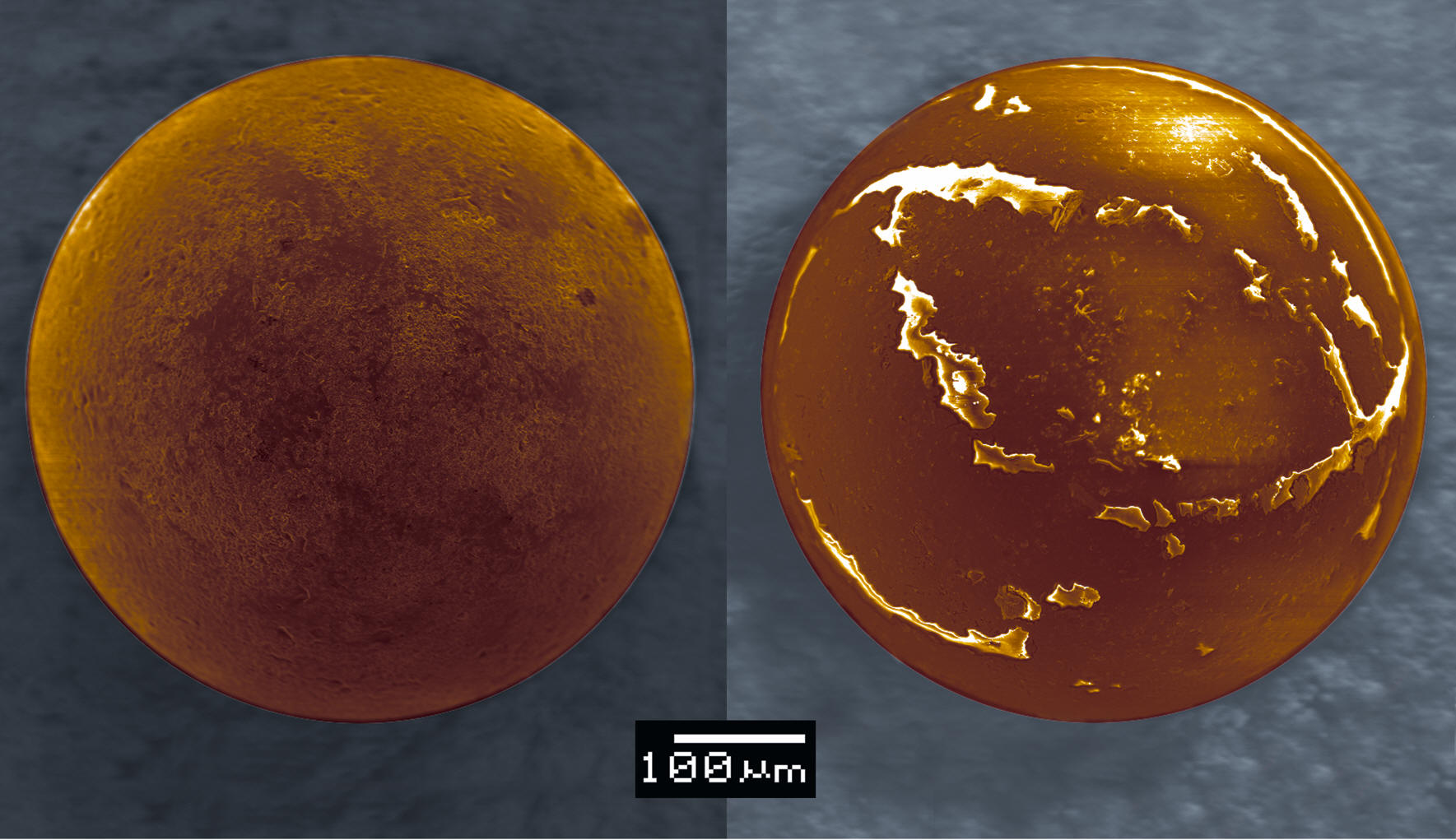
Sonochemical surface modification also helps in the encapsulation of polymer beads (0.6 mm) with copper (see below). Metal coated beads are under investigation to improve the performance of solder joints used to attach chip carriers to printed circuit boards.
The Evaluation of Sonochemical Techniques for Sustainable Surface Modification in Electronic Manufacturing; Cobley A J, Mason T.J., Trans. IMF, 87(4), 173-177, 2009.
Polymer Science and Technology
There are several ways in which ultrasound has been used in Polymer science and technology. The best known commercial application is probably the welding of thermoplastics, a process which lends itself readily to automation. In the process ultrasound is applied to two layers of plastic, heat is generated at the interface causing the material to soften, and flow, and the two layers are subsequently glued or joined together.
Molecular Weight Reduction - Polymer Degradation It has been known for some time that long chain molecules are broken down by ultrasonic waves. Although the exact mechanism by which this occurs is open to question, it is generally agreed that it is the hydrodynamic forces that are of primary importance. It is also believed that ultrasonic degradation, unlike chemical or thermal decomposition, is a non-random process with cleavage taking place at roughly the centre of the molecule and with larger macromolecules degrading the fastest. The consequence of this is that the larger molecules are preferentially degraded. It is also known that there is a limiting molecular weight below which degradation does not take place. This limiting molecular weight has the added effect of narrowing the molecular weight distribution.
Polymer Synthesis Early investigations into the use of ultrasound in polymer synthesis involved sonicating solutions containing a polymer and a monomer. Polymerisation was thought to be affected by utilising the shock wave energy, released on bubble collapse, to homolytically break a carbon-carbon bond in the polymer's backbone thereby producing a radical entity which could attack the monomer and polymerise by a conventional mechanism. The sonochemical generation of radicals has also been utilised to improve emulsion polymerisation
Polymer Encapsulation Over the past 30 or so years there has been a general interest in the development of technologies for the encapsulation of fine inorganic powders with organic polymers. The general aim of encapsulation is to affect the physical properties of such powders particularly in terms of increasing their dispersability in solvents or in composite phases. For example, if the end use of the powder is to be in either the coating field or the production of speciality films, then the two factors which dictate optimum physical properties are firstly an even and small particle size of the original powder, and secondly a uniform coating of each and every particle.
Most paint formulations contain pigment particles produced by ball milling. Unfortunately during storage there is a problem with the re-agglommeration of the pigment (e.g. TiO2) which ultimately leads to poor coverage and a patchy appearance of the final paint product. By applying ultrasound to the pigment in an emulsion system (water, surfactant and monomer) we were able to show that it was possible to produce the “ideal” pigment for formulation purposes where each particle was separated from its neighbour and was totally covered with polymer and had no tendency to reagglomorate (see figure below). The effect of ultrasound on the encapsulation of titanium dioxide pigment, J.P.Lorimer, T.J.Mason and D.Kershaw, Colloid and Polymer Science, 269, 392‑397, 1991.
The Preparation of Nanomaterials
There are close to 20 different methods for the fabrication of nanomaterials, these are regarded as the chemical and engineering materials of the future. What makes the use of power ultrasound effective and different from the other methods of synthesis are properties such as:
· The ability to produce nanomaterials in the amorphous state. This is of particular importance in catalysis, magnetism, coatings etc. · The shorter reaction times involved e.g. mesoporous materials (MSPM) can be prepared in hours (it normally takes days by the sol–gel method). · The insertion of nanoparticles into the pores of MSPM without blockage of the pores. · The syntheses of inorganic fullerenes at room temperature. Other methods normally require high temperatures.
Power ultrasound provides one of the most exciting ways to synthesize pure and supported nanomaterials for research and industry. This is due to the high temperatures and pressures created during the collapse of an acoustic cavitation bubble is on a microsecond time scale and is associated with a rapid cooling rate (> 109 K/s) which is much greater than that obtained by conventional rapid cooling techniques (105-106 K/s). This means that sonochemistry can be used to prepare amorphous nanosized metallic particles. Also, since the thermal conductivities of metal oxides are generally much lower than those of the metals, these faster cooling rates are necessary to prepare amorphous metal oxides.
The Sonochemistry Centre was involved in the preparation of nanoparticles through an EU programme entitled “Development of multifunctional nanometallic particles by Sonoelectrochemistry” (SELECTNANO). This aimed to manufacture new metal and transition metal nanoparticles for dedicated new applications, using the novel process of sonoelectrochemistry..This technique combines electrolysis with sonolysis. The sonication horn serves as a cathode for the electrolysis process and as a vibrational source of ultrasonic waves. A short electric pulse serve to reduce ionic species and deposit seed nanoparticulate metal crystals on the cathode. This is followed by a short ultrasonic pulse causing these nanoparticles to fbe released into the electrolysis mixture. Repeated sequential pulse then provide a semi-continuous method of generating the metallic powders.
This technique will be applied to fabricate nano Mg, Al, Fe, Co, Cr as well as nano alloys such as Fe-Cr, Fe-Mn, Fe-Co, and Cu-Sn which are foreseen to have a wide range of applications. Once formed, these nanoparticles can also be adsorbed onto stabilizing matrices such as colloidal dispersions using surfactants and polymers.
Sonoelectrochemical Synthesis of Nanoparticles, V. Sáez and T.J.Mason, Molecules, 14, 4284-4299, 2009. Sonoelectrochemical (20 kHz) production of Co65Fe35 alloy nanoparticles from Aotani solutions, M. Dabala, B. G. Pollet, V. Zin, E. Campadello and T. J. Mason, J Appl Electrochem, 38, 395-402, 2008
| |||||||||||||
|
|